Purchases of our 2025 PA Calendar and PA Amusement Parks Book

2025 PA Calendar & PA Amusement Parks Book Purchase Options

5.21.2017

Tobin's World Class Sculptures in Quakertown

If you have ever driven through the northern edges of Quakertown along California Road, you may notice some spectacular, root-like sculptures scattered around an otherwise mundane industrial park. These works have been created by Steve Tobin, a world-renowned sculptor, whose work is seen worldwide. His most acclaimed work is the "Trinity Root," a public sculpture created as a memorial to a giant 70 year old sycamore that was smashed when the World Trade Center collapsed on 9/11. The sculpt depicts the stump and roots of that beloved tree, a peaceful and beautiful tribute to that fateful day for the country and the world. That work was moved by the church from the 9/11 site, to their retreat center in Connecticut. It is caught up in a high-profile lawsuit regarding the intentions of an artist when it comes to public works. 
Tobin's studios serve as an art studio and a foundry. He originally hails from nearby Montgomery County and he graduated from Tulane University with a degree in Theoretical Mathematics. After not finding a career in that field, he took up odd-jobs in museums, which eventually lead him to this. His prowess in math, couples with his artistic sensibilities, and leads towards magnificent creations. He has transformed an otherwise mundane industrial park with his work. 
His studios are occasionally open to the public, but you can always see his work in this area of Quakertown. The sculptures are definitely worth seeing if you are in the area. For more information on his work, and about open houses, check out his website at http://stevetobin.com

5.18.2017

Lewistown's Old Stone Arch Bridge Park: Quaint 200+ Year Old Bridge

Dating back to 1813, Lewistown's Old Stone Arch Bridge is seriously old. No known bridge older than this exists west of it in the entire country. The borough of Lewistown has done something that I wish would happen with all classic bridges that are no longer capable of handling traffic, opening it and the surrounding area up as a public park. Included are benches for reflection and more. This quaint bridge was used for the Harrisburg-Pittsburgh Turnpike, not to be confused with the Pennsylvania Turnpike.
It is one of the top 50 oldest bridges in the country, according to bridgehunter.com, having been constructed more than 200 years ago. As I visited, there were people walking their dogs, laying out, picnicking, doing school/office work on laptops, taking photos, and more. It is an excellent place to pull off and relax along the old William Penn Highway corridor in Mifflin County. The bridge was stabilized and rehabilitated in 2006. 
If you noticed how high the mud line is, you can tell that this area had recently experienced high water conditions. This quaint bridge has a stunning history and is well worth checking out if you are in the area and looking for a place to relax.

5.16.2017

Lewistown Station: Oldest Pennsylvania Railroad Station

Lewistown, PA is home to the oldest known structure built by the Pennsylvania Railroad. This quaint building in Mifflin County dates back to 1849 and is located on the old Pennsylvania Railroad Main Line. The line west of Harrisburg now serves as a Norfolk Southern Line, and the line is leased to Amtrak for its daily usage. This section of the line gets two daily passenger trains, with one heading westbound to Huntingdon, Tyrone, Altoona, Johnstown, Greensburg, Latrobe, and ending in Pittsburgh, and the other heading eastbound to Harrisburg, Elizabethtown, Lancaster, Exton, Paoli, Philadelphia, Trenton, and eventually ending in New York City. 

Historically in regards to the Pennsylvania Railroad, Lewistown was the railroad's gateway to the west. From Lewistown, the railroad would largely follow the route of the old Pennsylvania Main Line Canal west through Pittsburgh. Additionally, Lewistown would serve as a junction point with several other short line railroads. Lewistown is also the closest train stop to State College and Penn State University, located only 30 miles north of the station.
This old depot is magnificent and it gives a great glimpse into what railroad stations looked like in small cities along PRR mainline. It is also a labor of love, operated exclusively by volunteers who appreciate the heritage and history of the railroad and region. The station serves as a sort of operating museum, with all sorts of artifacts from the old days of the Pennsylvania Railroad. The Pennsylvania Railroad Technical and Historical Society maintains archives at the old depot.
A small railyard is operated adjacent to the station.
In my opinion, the most comfortable way to travel is by way of train. Lewistown has the added benefit of offering completely free parking to travelers.
Lewistown Station is a special place that you definitely need to check out, especially if you are into railroading.

5.14.2017

Sherman Memorial Lighthouse: A Gem on the Allegheny River

As you drive up the Allegheny River from Pittsburgh, it does not take long to see how wild and scenic the river gets. When you get up to Tionesta in Forest County, one of the small towns located alongside the river, you will see a lighthouse not unlike those you see in places like Coastal Maine. This is an odd thing to see, for while the river is navigable at this point, the lighthouse is not needed for navigational aid. Instead, a group of citizens in the town have created an attraction with one of the few inland lighthouses in the state. Erie and Philadelphia are the only direct port cities in the state. Several of the lighthouses in Erie are considered to be inland lighthouses, meaning they are not considered to be meant for navigational aid. The Turtle Rock Light at Boathouse Row in Philadelphia, while it is pretty much an inland lighthouse, is still considered necessary for navigation. The Sherman Lighthouse is an unusual thing to see within Pennsylvania. 
The lighthouse is fully operational and it was a dream come true for lighthouse aficionado Jack Sherman. It is now named in his honor as the Sherman Memorial Lighthouse. It has seven floors and is open to the public for three days of the year. The profits from the tours go to the Tionesta Lions Club. This photo shows the sun almost aligned with the lighthouse, making it look as if the sun is the light within the building.

The Tionesta Dam impounds a reservoir, which has boat launches, a beach, a campground, general picnic areas, fishing, and hunting opportunities. It also serves as a gateway to the nearby Allegheny National Forest, making this an excellent launching point. The dam was built between 1938 and 1941 as a direct reaction to the devastating St. Patrick's Day flood of 1936 in Pittsburgh. It serves as a flood control barrier and it created a new habitat and recreation area.

From here, you can launch further into the beautiful and scenic ride up the Allegheny River and into the Allegheny National Forest. The ride is beautiful all the way up through the Allegheny Reservoir and into the Seneca Nation Indian Reservation in the area of Salamanca, NY. A very scenic and awesome drive. 
For those of you who love hiking, there are a number of great trails, including the North Country Trail that meanders from New York to North Dakota. Some of my favorite hikes are located along this route, including those in McConnells Mill State Park in PA, the Allegheny National Forest, and Treman State Park in New York. The NCT travels right through here and it is absolutely beautiful.

All in all, this is a place that gets our thumbs up. You need to explore it and check it out. This place is filled with adventure. 

5.10.2017

Bethlehem's Moravian Book Shop: Oldest Bookstore in North America

Bethlehem is always a joy to visit, and one of its most vibrant institutions is the Moravian Book Shop. It is the oldest bookstore in North America, and second oldest in the world to Lisbon, Portugal's Bertrand Book Store, though that store has not remained in continuous operation. Moravian Book Shop dates back to 1745, and has continuously operated since that point, making it the world's longest continuously operating book store. It was previously known as the Bethelhemer Bücher Shop and moved to Philadelphia for two years in 1856. The shop returned to Bethlehem in 1858, opened in its current building in 1867. It acquired its current name in 1905. As soon as you walk in, you know you are visiting a special place. It is an inviting place, with lots of great books, nifty gifts, a nice cafe, and a sprawling bookstore that has expanded into a number of adjacent buildings over the years.

In addition to books, the store is home to a nice deli, a specialty food store, and the Moravian-Bethlehem Room, which specializes in local and traditionally Moravian items, including Moravian/Advent Stars, 26 point stars that are traditionally hung in windows and on porches. 
Historic Hotel Bethlehem 
It is located at the heart of the Moravian Historic District, adjacent to the church grounds, Moravian College, the historic Hotel Bethlehem, and the Colonial Industrial Quarter.
The shop has an excellent collection of books, a true gem of the community.

When we first released our book, Great Pennsylvania Amusement Parks Road Trip, the Moravian Book Shop graciously hosted a book signing for us. 
As soon as you walk into the Moravian Book Shop, it is clear that this is a special place and it is immediately evident why it has remained a staple in Bethlehem for the better part of three centuries. A stroll through the store, and historic downtown Bethlehem, is a must for any history lover. Bethlehem has intact historical institutions, buildings, remnants, and more, that run from colonial times all the way to today. It is a truly special place to visit and we highly recommend it. 

For more information on how to visit, check out their website at www.moravianbookshop.com

5.07.2017

Fountain Hill's Lechauweki Springs: A Lost Victorian Resort

Today we visit the location of a largely forgotten old resort from the Victorian Era, Lechauweki Springs. The name Lechauweki is the Lenape Indian word for the Lehigh River. The springs are located on a hillside in Fountain Hill. The borough of Fountain Hill is technically considered a suburb of Bethlehem, though for all intents and purposes, it is practically a neighborhood of Bethlehem. It is located just across the Northampton County border from Bethlehem in Lehigh County. The large St. Luke's Hospital was built in the borough and it has long been the primary hospital for Bethlehem. Fountain Hill and Bethlehem are adjacent to each other and almost fully intertwined. 

Edwin Drake, the driller of the first successful commercial oil well in Titusville, lived out his remaining years in the Fountain Hill/Bethlehem area. He moved to the area after word of his poor health spread, and a great outcry and charitable outreach ensued. The Pennsylvania General Assembly gave him a 1500 dollar pension.

A man by the name of Francis Oppelt utilized springs nearby to create a hospital. He had no medical training, but he believed that drinking and bathing in pure water could cure all ailments. His facility was known as "Oppelt's Water Cure" and the "Hydropathic Institute."  His facility was founded in 1846 and went out of business in 1871, a year after Drake moved to the area. St. Luke's Hospital opened up on Oppelt's land in 1872. Drake's move to Bethlehem was likely for the supposed healing powers of the mineral springs in Fountain Hill. The water cure was highly sought out, even attracting General Sherman from the Civil War. Drake died in 1880. He was buried with a pauper's burial in Bethlehem, and was transferred to his grand burial plot in Titusville in 1902. The giant memorial was commissioned by Henry Rogers of Standard Oil.  

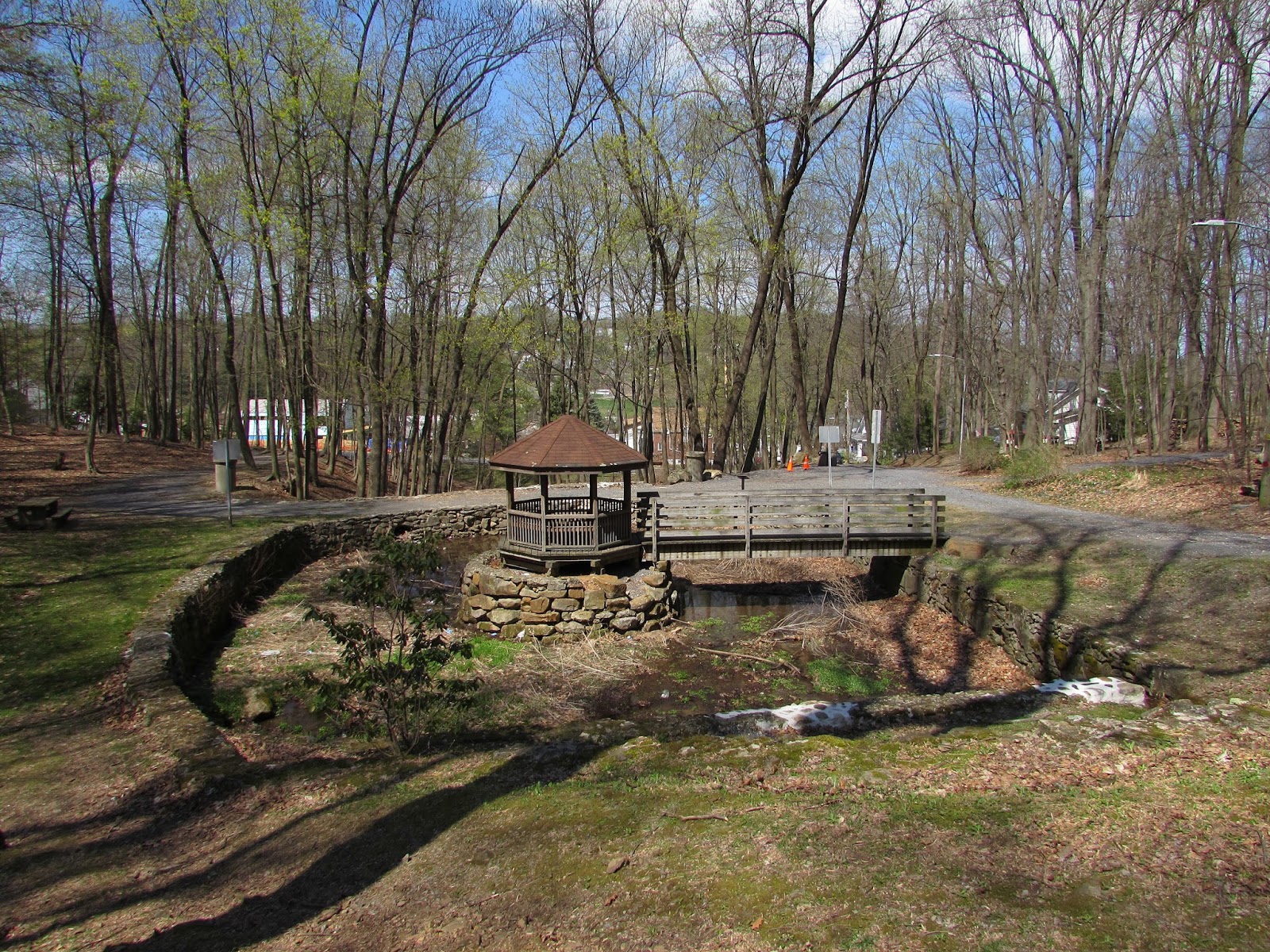
The mineral springs in Fountain Hill lead to the creation of Lechauweki Springs, about a mile away from the former site of Oppelt's Water Cure. People would ride the Lehigh Valley Railroad from New York and Allentown, and others would ride the Reading Railroad from Philadelphia and other places to spend time at these springs. A dance hall, entertainment facilities, accommodations, and more were set up here. People sought out the clear air, cool nights, parties, and the healing powers of the mineral springs, offered at Lechauweki Springs. A public park has been set up at the location, and a number of artifacts remain. A gazebo was rebuilt at the location where one once stood. The springs still flow through the area, though they are rather small. I initially came to see the remnants, which are pretty neat unto themselves, but I ended up really enjoying the cool temperatures of the forest, just as a visitor may have more than 140 years ago.

Some skunk cabbages growing
Some of the beautiful forest on the slopes of this park
The resort had three buildings, with 120 rooms. The success was short lived, only lasting from 1876-1880 or so. Business slowed down through the 1880s, and the resort shut down after a major fire in 1891. A number of private cottages built upon the road heading into the park remain as private residences to this day. 

A postcard view of the resort during its heyday. It is hard to imagine this serene area being hit o such a massive resort.
There were three large trout ponds, with the remains of one of them seen here. 


The trout pond above, seen during the times of the resort. Photo credit to the Morning Call
The springs
The remains of one of the resort's three cold cellars. These stored provisions from the hotel.
Lechauweki Springs is a beautiful place that you should certainly check out. If you are in the area, or better yet, if you live in the area, this is certainly place that you will enjoy exploring. There is a natural draw to this location, making it clear why the resort was built in the first place. 


5.02.2017

Tidioute Overlook: Allegheny National Forest, Warren County

The Allegheny National Forest's Tidioute Overlook provides a tremendous vista of the Allegheny River and its gorge, with one side showing a view of Courson Island, part of the Allegheny River Islands Wilderness Area, and the other showing the small village of Tidioute. A short hike takes you to both overlooks and a nice picnic area is provided. This portion of the river is designated as "Wild and Scenic" and it certainly shows. 
Decisions, decisions! It is easy to do both, with the hike being no more than a quarter mile or so between both. 
As mentioned earlier, Courson Island is designated as a Wilderness area. A series of islands on the river have been given this designation in order to preserve them as undeveloped examples of river coast line. This area of the river is rustic and beautiful. 
The picnic area itself is beautifully wooded, certainly a great place to go on a hot summer day to cool down a little bit and catch some awesome views. 
The overlook of the borough of Tidioute shows a place that was once a sawmill and oil boom town. The town is still intact and it has some beautiful old buildings, but at one point this boomtown was the birthplace of Standard Oil, Rockefeller's oil company that would eventually be broken up as a monopoly. The borough was also home to one of the region's perennial industries, knife making. Tidioute Cutlery began in the borough, and was moved in 1911 to Olean, NY, a place located up the Allegheny River and not terribly far from this location. There are still a few knife makers around the region, namely in Titusville. Union Cutlery itself would go on to have an illustrious history, namely with their KA-Bar branded knives, which started becoming standard issue in the military in World War II. They still operate from the small town of Olean, NY to this day. All of this history began right here in Tidioute.
The Tidouite Overlook is certainly a place you should check out while you explore the Allegheny National Forest.

Coordinates:
41.675274, -79.392834

Blogger Widget