Purchases of our 2025 PA Calendar and PA Amusement Parks Book

2025 PA Calendar & PA Amusement Parks Book Purchase Options

3.11.2014

Pittsburgh East Liberty Overview Part 1

I initially set out to write about the Motor Square Garden. I will write about it tomorrow, but first I am writing an overview of the East Liberty neighborhood to provide context. This context is needed to understand the neighborhood and some of the struggles in the city. The rebirth of East Liberty happening right now will be the center of rebirth for the entire area.

Pittsburgh's East Liberty Neighborhood has a varied history, having gone from a top tier place to a tough place and to a neighborhood starting to upswing today. Early in the neighborhood's history, as the name "Liberty" in traditional English represents, it was the outskirts of the city. In Philadelphia you hear of the Northern Liberties section in the same sense of the name. East Liberty was primarily used for grazing animals and farming. The area was a fertile area for growing. A familiar name to Pittsburghers is Alexander Negley. A street named in his honor runs from East Liberty and through the Bloomfield/Friendship and Shadyside neighborhoods. In 1816 Negley had the foresight to have the Pittsburgh-Greensburg Turnpike run through the area. This made East Liberty a huge trading center. Later on, lawyer Thomas Mellon would marry Negley's daughter and East Liberty would thrive. The place further boomed as a trading center when wealthy industrialists would settle in nearby Point Breeze and Shadyside and shop in East Liberty. Mellon money would pour into the neighborhood and his influence would bring the streetcar routes through the neighborhood.

East Liberty lies in the center of Point Breeze and Shadyside where the wealthy lived, Highland Park and Friendship where the professionals lived, and Bloomfield and Garfield that were primarily blue-collar neighborhoods. In the 1960s with big businesses moving to the suburbs, a plan was carried out to attempt to create more neighborhood automobile accessibility through creating a circle route named Penn Circle. The problem with creating this was that they needed to cut down a huge chunk of the existing buildings, creating a disjointed neighborhood in which pretty much all of the businesses ended up leaving.

Additionally, during the "Urban Renewal" phase of the 1960s, a period which was devastating to the Black community of Pittsburgh, many Black families were forced to move from their traditional neighborhoods, especially the Lower Hill District in Pittsburgh, that was located at the former home of the Civic Arena. This area was known as the best Black cultural center neighborhood between Harlem and Chicago. Jazz legends like Louis Armstrong, Duke Ellington and others frequented this thriving community. The area was bolstered by the Great Migration, creating a booming and eclectic community. 

The Lower Hill District Neighborhood was the home of the legendary George Benson, arguably the greatest living jazz musician. He played the Ukulele and Guitar on the street and was discovered. He started as a child prodigy in the 50s, playing different venues and he was eventually discovered as a great talent by the record companies. The areas he frequented, the areas that helped him become a legendary musician, are all gone. The primarily Black families who lived in the thriving Lower Hill were all evicted from their homes by eminent domain with two days notice, uprooting families into migrant status.
Pittsburgh Press August 16, 1958. "Exodus?" More like forced migration. What an awful chapter of history. 

The same situation occurred at both the Point in Pittsburgh and the failed Allegheny Center project in North Side. The thousands of Black families that were kicked out of their homes migrated to Homewood and this region became overcrowded. The next plan was to create tower housing projects in East Liberty. Anyone who is from a city or knows of the tower housing projects in the 1960s knows that these failed miserably. The same happened in East Liberty. The horror stories from folks that lived in these types of high rise housing projects are terrible. These problems led towards a further vacating of the neighborhood. 

The area is slowly recovering from all of these problems. The businesses are returning. A Target and Home Depot are located in the area with many other stores filling in from all borders. The future is looking bright. Lots of small and popular eateries are coming along with small businesses. Plans are in the works to create mixed income housing and the future looks bright for this neighborhood. The problems it has dealt with are devastating and I wish the best for the future. If they can once again help this area to boom it will benefit not only East Liberty, but all of the surrounding neighborhoods that could use a boost. In the 6 years that I have lived in Pittsburgh this neighborhood has steadily improved. If it continues at this clip, this fractured area should be fully booming once again as a great urban center. You can the spark with the reopening businesses, neighborhood improvement projects such as mural painting and the weekly farmers markets. This is turning into a vibrant neighborhood once again.

I wrote quite a bit more about East Liberty than I wanted to, but this context needed to be set to fully understand the neighborhood and the difficult odds the Black community in Pittsburgh has faced. It is never easy to talk about racial problems but I feel this is something that needs to be fully addressed to help fix the biggest problem that Pittsburgh faces. Tomorrow I will write about what I originally set out to write about, Motor Square Gardens in East Liberty. The rebirth of East Liberty at this point will prove beneficial for all folks that live in and around East Liberty in creating steady employment in an area that really needs it.


3.10.2014

A Look at St Paul's Cathedral in Oakland, Pittsburgh

St. Paul's Cathedral is the motherchurch of the Pittsburgh Catholic Diocese. It has a congregation that dates back to 1834, 9 years before the incorporation of the diocese. The congregation was initially based downtown but in 1906 it moved to Fifth Avenue in Pittsburgh's Oakland neighborhood with the shifting of the city's population outwards. Oakland was becoming a bustling center of the population. It is difficult to imagine but at this point parts of Oakland were still farmland. The church was built at a cost of 1.1 million in 1906 dollars, or over 27 million today with inflation.
You can see this church's two 247 foot spires all over Oakland for the church sits on a hill. Off to the right you can see Pitt's 535 foot tall, Cathedral of Learning. You can read more about it in one of our previous posts. 


The building is decorated in classic Gothic style, much like the building's younger sibling and neighbor, the Cathedral of Learning. It is a spectacular building to check out. The decorations are elegant and this 108 year old church building is truly spectacular. 

3.08.2014

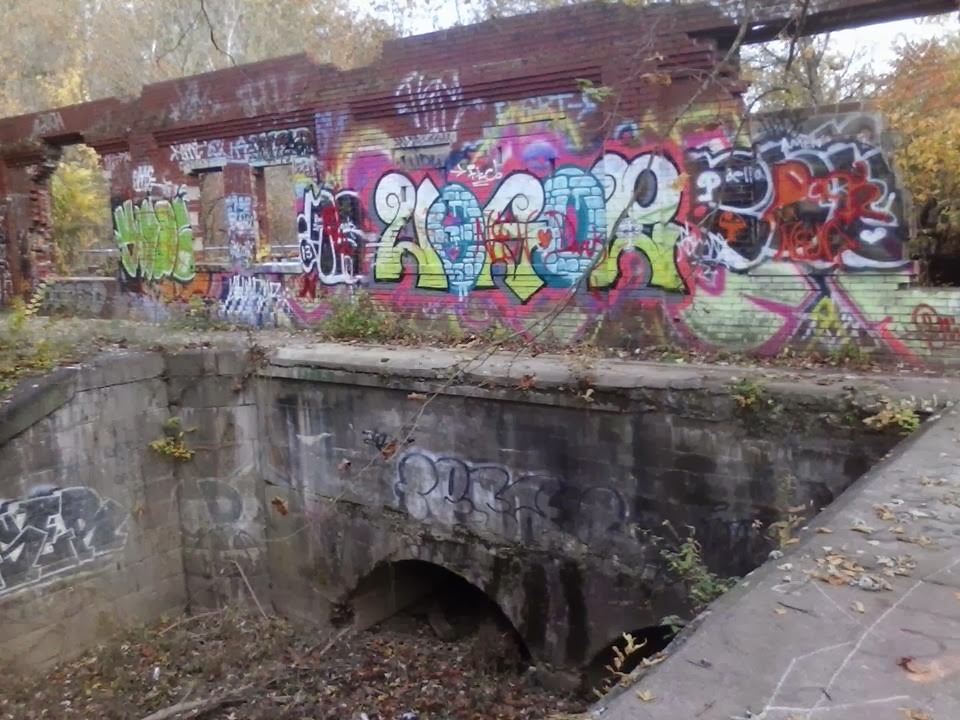
Schuylkill Canal Pump House Remains in Manayunk from our friend Crissarobin

From our friend CrissaRobin: "Hi! I just wanted to share one of my interesting finds with you. I was running in Manayunk, pulled a calf muscle and hobbled my shamed but into the woods. I literally stumbled upon this old ruin. I think that it was a lock or pump house. It sits on top of a canal that runs next to the Schuylkill. You can move a girl to Philly but she'll always end up wandering around the woods. Cheers!"

This is a pretty cool find. Thank you! I found this information on the Schuylkill Canal on Wiki. I will have to explore it and research it more. The old canal systems next to the rivers are always something that have fascinated me. The switch to railroads and then the further move towards roads, cars and tractor trailers is something that fascinates me as well. Thank you for the find!


3.07.2014

Raccoon Creek State Park: Former Frankfort Mineral Springs

Yesterday on the Facebook page I posted this mysterious photo.
We got several cool responses. They were all plausible but not correct.

These are the remains of the Frankfort Mineral Springs at Raccoon Creek State Park. Frankfort Mineral Springs was once a thriving resort based around mineral springs that were believed to have healing powers. In the mid 19th century the idea that these mineral springs had healing powers swept across the nation. Folks from far and wide would go visit these mineral springs to cure them from their different ailments. A similar resort still remains in Bedford at the Bedford Springs Resort, the summer resort for the only president to ever come from Pennsylvania, James Buchanan, the man who oversaw the splintering of the union and uprising of the Civil War, but I digress.  

These mineral springs resorts were very popular in the Victorian era, but tastes changed in the early to mid 20th century. There are a few things remaining from the resort including this cut out area where the mineral springs were located and the shells/foundations of a few buildings. The resort used to have things like a dance hall, hotel building, stables and more. The remains of the resort are pretty cool to check out. The state park is very beautiful. The place is wooded, has a wonderful campground and a nice little lake. It is a great place to lose yourself for a day or two and just relax. 

3.04.2014

Coltart Street In Oakland, Pittsburgh: 1908 compared to now

I happened to run into some awesome photos from the Pittsburgh City Photographer's Collection. Easily some of the coolest period photos. This looks like your average street, with homes that it is hard to tell just how hold they are.


Now let's travel back to these awesome photos from 1908. The large apartment building with balconies is already built and looks a hint newer. 
Steam shovel! Look at that! Steam powered digging equipment with rails in place to help move it. When I first saw this picture my mind was blown. Wow! It makes you think of just how much hard work has gone into building this neighborhood.

It is almost disorienting seeing this view. On this corner to the right is a 3 or 4 story building housing an organization called Peoples Oakland that helps folks overcome mental illness. Right next to it is an old building with a copy shop in it.
Looking from the other direction. These photos blow my mind in how they capture the moment this block was being built up over a hundred years ago.

3.03.2014

Follow-up post to "1920 to now: Oakland, Pittsburgh, Forbes intersecting with Semple and McKee"

The other day in this blogpost I mentioned the Family House on McKee in Oakland as a remaining mansion of that group of mansions. The organization in the building has a wonderful mission, giving folks from out of town that have friends or family members an inexpensive place to stay while they receive the medical treatments they desperately need. They re-purposed this former mansion on McKee to serve that need and from there they have grown to several locations around some of the world class hospitals in the area including UPMC Presbyterean, Mercy, Shadyside along with West Penn Hospital and Allegheny Hospital. The mission of this organization is noble and they re purposed this character filled old building for this mission instead of it meeting the wrecking ball fate that the rest of the local mansions met. 

Here are some photos I took today of the re-purposed mansion


3.02.2014

The University of Pittsburgh Cathedral of Learning on a Snowy March 1st, 2014

We had a pleasant Sunday adventure through Oakland in the beautiful snow today. In this first shot you see the iconic O Hot Dog Shop, the Schenley Quad which dates back to the 20s, the Towers dorms and the Cathedral of Learning looming in the back.

The Cathedral is where we were headed
On the left you can see the William Pitt Student Union. It was originally the home of the Schenley Hotel, a place where folks like Richie Ashburn, Babe Ruth and other legends would stay when they played at the nearby former Forbes Field.

Almost there....
Brit looking all warm
Beautiful
The small building on the right is the Stephen Foster Memorial. He is the legendary musician that wrote songs like Oh Susanna and Camptown Races. 
A look at snowy Oakland from the 36th floor. The large building complex is the Carnegie Museums of Art and Natural History along with the Carnegie Library and Music Hall. 
Frick Fine Arts is the building center left and you can barely see the Phipps Conservatory in the distance on the left. The empty area in the center is the Schenley Plaza, a place where folks throw frisbees and sunbathe on warmer days. The large circular structure is a pavilion and the small circle next door to that is a carousel. 
The building at the bottom of this shot is the Pittsburgh Athletic Association and the building middle-left is the Soldiers and Sailors Memorial Museum and auditorium. We saw Joe Grushecky and the House Rockers jam out with Bruce Springsteen in the auditorium a few years ago. The empty plot to the right of it was the home to another auditorium, the Syria Mosque, which was torn down by UPMC to create a parking lot. 
The center building is Pitt's Alumni Hall. This building was originally a Masonic Temple

We now head down the main floor, home to the commons room and some spectacular vaulted ceilings
The architecture of the Cathedral of Learning is truly spectacular.
This is the best place to relax and study. Not too many folks trekking out into the snow on a Sunday to go and take advantage. As a student we both would go and study here. 
Every little detail was paid attention to when this building was built. 
Right down to the framing around the radiators
Such a spectacular place. This building was planned and erection started during the splendor of the Roaring 20s. Construction was halted when the Great Depression kicked in. Thanks to philanthropy and donations by the many cultural groups that create the diversity of the region, the construction eventually continued and the building would be completed as the centerpiece of a learning community and hub for the whole community to visit, learn in and enjoy. 
Brit is ready to go!
There is a cool balcony heading out of the building. All in all this is a cool place, especially in the middle of a snowstorm. 
Blogger Widget